Precision Woodworking Lighting: CRI & Placement
By Maya Iqbal • 7th Mar
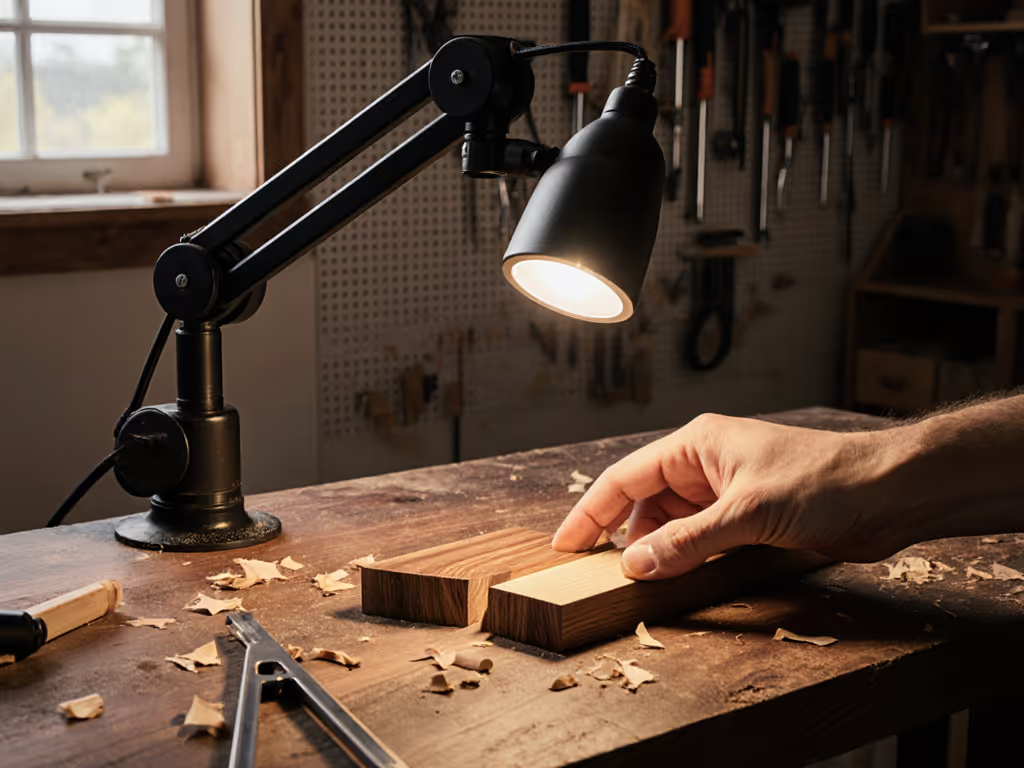
You cannot optimize what you do not measure. That principle guides my approach to shop lighting just as it does workbench engineering. Precision woodworking lighting is not about aesthetic preferences or brand names (it is about spectral data, beam geometry, and task-specific color fidelity). When you are evaluating joinery fit, matching stain colors, or inspecting glue squeeze-out, your eyes rely entirely on light quality. The wrong tool bench light will cost you accuracy, speed, and repeatability far more than a wobbly clamp ever could.
Workshop lighting receives less technical scrutiny than it deserves. Most makers treat it as an afterthought (install whatever fixture fits the ceiling, call it done). That approach produces shops where shadow patterns hide glue failures, color casts prevent proper stain assessment, and eye strain kills focus during detail work. The good news: applying measurement standards to your lighting, not guesswork, transforms the entire experience. To choose the right technology for your fixtures, see our LED vs fluorescent tests with verified CRI, R9, and efficiency data.
What Is CRI, and Why Does It Matter for Your Workbench?
Color Rendering Index (CRI) measures how accurately a light source reproduces the true colors of an object compared to natural sunlight. CRI is rated on a scale of 0 to 100. A light source with 100 CRI renders colors with perfect fidelity; lower values introduce hue shifts, desaturation, or color casting.
For color accuracy lighting in woodworking, CRI directly affects your ability to:
- Judge wood tone and grain before committing to glue-up
- Assess stain penetration and uniformity across a panel
- Spot glue squeeze-out before it dries and hardens
- Evaluate finish clarity and sheen on test samples
- Match hardware finishes and decorator wood tones
In fine cabinetry and furniture making, a single mismatched board or stain error cascades into rejected work. The cost of redoing a door frame far exceeds the price difference between baseline and premium lighting. Control the variables, and the numbers will explain themselves.
CRI 80 vs. 90 vs. 95: Which Level Do You Actually Need?
CRI 80: Baseline and Limited Application
CRI 80 is the conventional standard for most commercial lighting fixtures. It is adequate for general storage, utility areas, and spaces where you spend minimal time. However, it has a critical weakness: most 80 CRI sources have an R9 value (red rendering accuracy) around 0. This means reds and warm wood tones lose saturation and can appear muddy.
For a woodshop, 80 CRI is acceptable only in outlying zones (assembly outfeed tables, lumber staging areas, or rough-milling stations where finished appearance is not yet in play). Do not use it over your primary workbench, assembly table, or finishing station. The low R9 value specifically undermines color-critical work. If you are staining cherry or evaluating a mahogany grain, 80 CRI will lie to you.
CRI 90: Premium Choice for Precision Tasks
90 CRI LED lights deliver superior color rendering compared to 80 CRI and provide a noticeable boost in color clarity. Most 90 CRI sources have an R9 value around 50, meaning red and warm tones reproduce far more accurately. The difference between 80 and 90 is immediately apparent under equivalent brightness.
For woodworking, 90 CRI is the practical baseline for any LED workbench illumination where finished appearance matters. This includes:
- Primary assembly and layout tables
- Glue-up stations where you must assess squeeze-out
- Stain and finish application areas
- Detail joinery and inlay work
- Inspect-before-pack stages of production
In residential and small-shop settings, 90 CRI balances cost, efficiency, and color accuracy. It is the "good fit" for areas where you spend the most time and where decisions about wood quality are made. Many manufacturers position 90 CRI as their premium offering, and for good reason. The perceptual jump is meaningful without the efficiency penalty of higher grades.
CRI 95+: Specialty Applications Only
CRI 95 sources offer the most accurate color rendering, making colors appear almost identical to natural daylight. Most 95 CRI sources have an R9 value around 90, achieving near-flawless red fidelity. However, higher CRI almost always correlates with lower luminous efficacy and higher cost.
For general woodworking, 95+ CRI is unnecessary unless you are:
- Reproducing artwork or sculptural finishes
- Photography of finished pieces for portfolio or e-commerce
- Extremely high-end custom work where color match to client samples is guaranteed
- Running a color-matching service or restoration practice
The cost-to-benefit ratio for 95 CRI in a typical workshop is poor. Invest the additional budget elsewhere (better optics, shadow-free geometry, or redundant fixtures for coverage instead).
Shadow-Free Workshop Light: Placement Strategy
Shadow-free workshop light is not about eliminating all shadows; it is about eliminating hard shadows that hide surface details. A shadow cast by your own body or hand tool obscures the very surface you are trying to inspect. Poor placement amplifies this problem.
Fixture Positioning Rules
Position lights at 45 degrees to your primary work surface. This angle minimizes shadows cast by your hands while maintaining directional definition that reveals surface defects, grain direction, and glue beading. A light directly overhead creates harsh shadows under joinery features; a light from the side alone leaves half the work in comparative darkness.
For a standard 4-foot by 8-foot assembly table:
- Mount one 4-foot linear fixture on each long side, roughly 3 to 4 feet above the surface
- Angle or aim them toward the table center at approximately 45 degrees
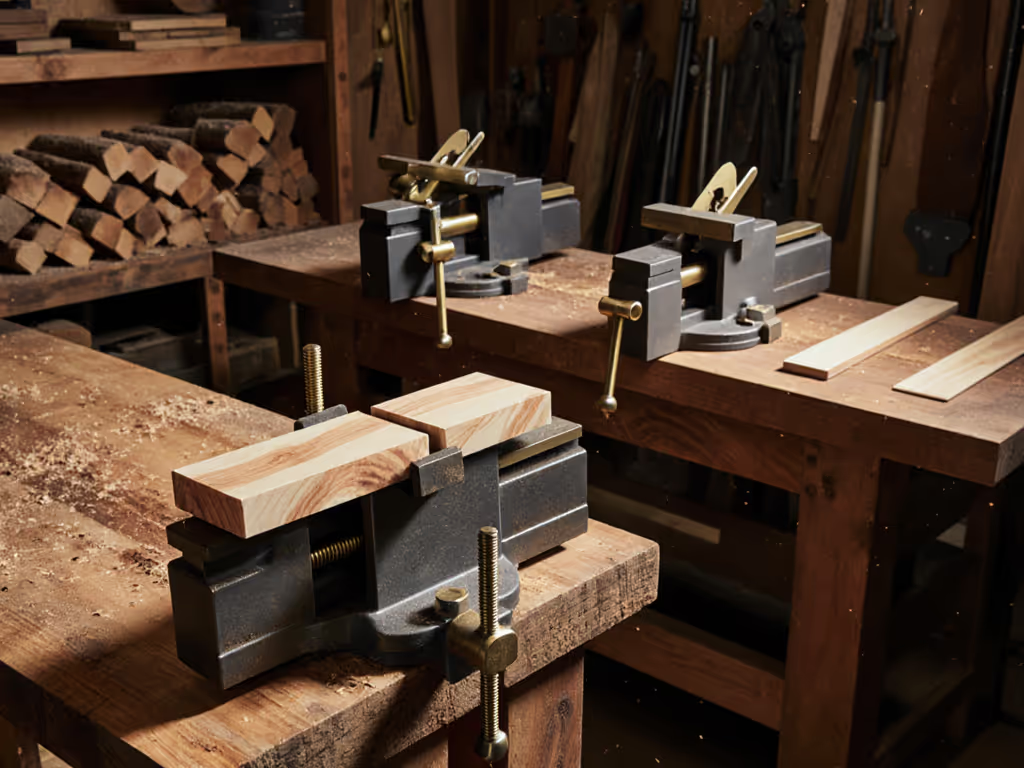
- Add a narrower fixture above the vise station, positioned to illuminate the clamped workpiece from above and slightly forward
This three-point arrangement prevents you from casting your own shadow onto detail work. For wiring routes, under-shelf strips, and switch placement around the bench, use our workbench lighting setup guide. When evaluating a mortise or checking for glue squeeze-out, your body will be positioned to the side, and overhead light will cross-light the joint.
Supplement with Task Lights
Woodworking task light placement is context-dependent. In addition to ambient overhead systems, mount individual directional fixtures:
- At the vise: a compact LED spotlight angled into the vise jaws, allowing you to inspect grain and surface as you adjust pressure
- Over the hand-tool station: a focused beam that illuminates planes, chisels, and your work surface without glare
- Near the finishing station: broad, even light (90+ CRI) to assess dry stain and gloss uniformity
Task lights allow you to dial in color and brightness for the specific operation without re-plumbing ceiling systems. Many makers find that a combination of moderate-CRI (80-85) ambient light plus 90+ CRI task fixtures over critical zones is more efficient and flexible than ultra-premium ambient everywhere. Before adding more task heads, plan safe power delivery with our workbench electrical integration guide.
R9 Value: The Hidden Metric
CRI is a composite score averaged across eight standard color patches. R9 measures saturation and hue accuracy for red specifically. Most 80 CRI sources have R9 ≈ 0; most 90 CRI sources have R9 ≈ 50; most 95 CRI sources have R9 ≈ 90.
Why does this matter for woodworking? Because many of your materials are warm-toned: cherry, mahogany, walnut, cedar, and ash all shift red. A light with low R9 will desaturate these tones, making it difficult to judge how a stain will actually appear under normal daylight in a customer's home. When you specify a fixture, verify the R9 value (it is not always published, but manufacturers will provide it on request).
For color-critical work, target CRI ≥ 90 with R9 > 0. This combination ensures that warm materials do not mislead you.
Efficiency vs. Quality: The Tradeoff
Higher CRI sources are less efficient (lumens per watt) than lower CRI sources at equivalent correlated color temperature (CCT). A CRI 95 fixture will use more power to achieve the same brightness as a CRI 80 fixture. This is a physics constraint, not a flaw.
For your shop, the tradeoff is explicit: either you accept lower efficiency and higher cost to gain color accuracy where it matters, or you accept color inaccuracy in those same zones. There is no free improvement. Mass and stance beat marketing. The same principle applies here. Do not chase specs you do not measure; instead, quantify the cost of a single color-mismatch rejection against the cost of premium lighting, and decide accordingly.
For most professional and serious-hobbyist woodshops, 90 CRI with good placement is the optimal operating point. You gain meaningful color fidelity without the efficiency penalty of 95+, and you avoid the color blindness of 80.
Recommended CRI Levels for Woodshop Zones
| Zone | Minimum CRI | Recommended CRI |
|---|---|---|
| Primary assembly & glue-up | 85 | 90 |
| Vise & detail joinery | 85 | 95 |
| Stain & finish application | 90 | 95 |
| Rough milling & outfeed | 70 | 80 |
| Lumber inspection & sorting | 80 | 90 |
| Tool maintenance area | 70 | 80 |
| Delivery/packing staging | 70 | 80 |
This tiered approach keeps cost and energy use reasonable while ensuring that every critical decision is backed by accurate light. You are not guessing. You are controlling variables so the numbers explain themselves.
FAQ: Common Questions About Shop Lighting Upgrades
Q: Can I just add more brightness to compensate for low CRI?
No. Brightness (lumens) and color accuracy (CRI) are independent variables. A very bright 80 CRI light remains color-inaccurate; you will simply see distorted colors clearly. It is worse than low brightness with good CRI, which at least preserves hue relationships.
Q: Should I upgrade my entire shop to 95 CRI?
Unless your primary business is color-critical restoration or custom finishing, no. Invest 95 CRI in the zones where color decisions happen (finish evaluation, stain sampling, detail inspection). Use 90 CRI for general assembly. Use 80 CRI only in non-decision zones (storage, rough work, outfeed). You will spend less while gaining practical accuracy everywhere it counts.
Q: What about color temperature? Does 4000K vs. 5000K matter?
Color temperature (Kelvin rating) is a separate specification. 5000K mimics daylight and is preferred for color-critical work because it is how customers will ultimately view the finished piece. 4000K (warm white) is acceptable for general work but can slightly mask how finishes appear in typical living-room lighting. For precision woodworking, default to 5000K CRI 90+ over your primary stations.
Q: I work in a small garage. Can one fixture do everything?
A single overhead 90 CRI linear fixture covering your main work surface will cover most needs. Add a 95 CRI task light over your finish-sampling zone if you do staining. This two-fixture approach is affordable, simple, and covers your critical bases without overkill.
Continuing Your Lighting Assessment
The next step is to audit your current shop lighting against these standards. Note the CRI of every existing fixture (check the label or spec sheet, and if you cannot find it, assume it is 80). Identify the zones where color decisions happen. Then, start with one zone upgrade (typically the stain and finish station) and measure the difference in your work quality and confidence.
Do this systematically. Do not chase the latest marketing claims about "full-spectrum" or "daylight-mimicking" without verifying the CRI and R9 numbers. Measure your current lighting, test a targeted upgrade, and let the results guide your next investment. That is how you build a shop where every tool (including light) earns its place through performance, not style. For broader hazard reduction around the bench, review our workbench safety guide.
Related Articles