MDF Workbench Performance vs Plywood for Composite Wood Work
By Maya Iqbal • 27th Jul
Quick verdict
MDF and plywood cannot be named a universal workbench-top winner from the available evidence: no controlled test directly compares them in this application. Choose based on the exact sheet or formulation and the requirements of your planned build, then test matched samples.
- Choose MDF if: You want to investigate a layered composite top and can validate flatness, deflection, fastening, and edge performance.
- Choose plywood if: Your specific sheet and construction pass your own workholding and stiffness tests.
- Main trade-off: In an experimental MDF series, moisture response varied by formulation. In Rob Cosman's practitioner experience, MDF has softer edges that may need treatment. Cutting and sanding any of these panels can create airborne wood dust, so exposure controls remain important.
Important: The evidence does not establish long-term service life, vibration behavior, surface friction, cutter wear, or dust differences between MDF and plywood.
If you plan to build a woodworking workbench, the honest answer on MDF workbench performance versus plywood is not a one-word material verdict. The available controlled evidence does not directly compare MDF and plywood as workbench tops. It does support a narrower conclusion: the reported results apply to particular panel samples, formulations, and test conditions. Treat the bench as a machine, not furniture: define the load case, then measure the result.
That restraint matters. Two benches can look identical until the load goes on. Paint, brand, and confident shop talk are no substitute for a measured trial.
FAQ: Is MDF or plywood better for a workbench top?
Short answer: the present evidence does not establish a winner
There is no collected controlled test that puts MDF and plywood workbench tops through matched tests for:
- vertical deflection under load;
- racking during planing or assembly pressure;
- workholding stability;
- vibration or resonance;
- surface wear, denting, glue release, or friction;
- long-term flatness and service life.
So an evidence-based overall MDF-versus-plywood winner would be invented, not measured.
That does not mean you cannot choose. It means the choice should follow your own bench configuration. Because workbench top thickness is one of the construction details worth recording, treat it as a controlled variable rather than a minor specification. For a broader comparison of workbench top materials, consider how MDF and plywood fit alongside hardwood, steel, laminate, and other surface options.
Do not ask which panel is "best" before defining the load, the support layout, and the workholding interface.
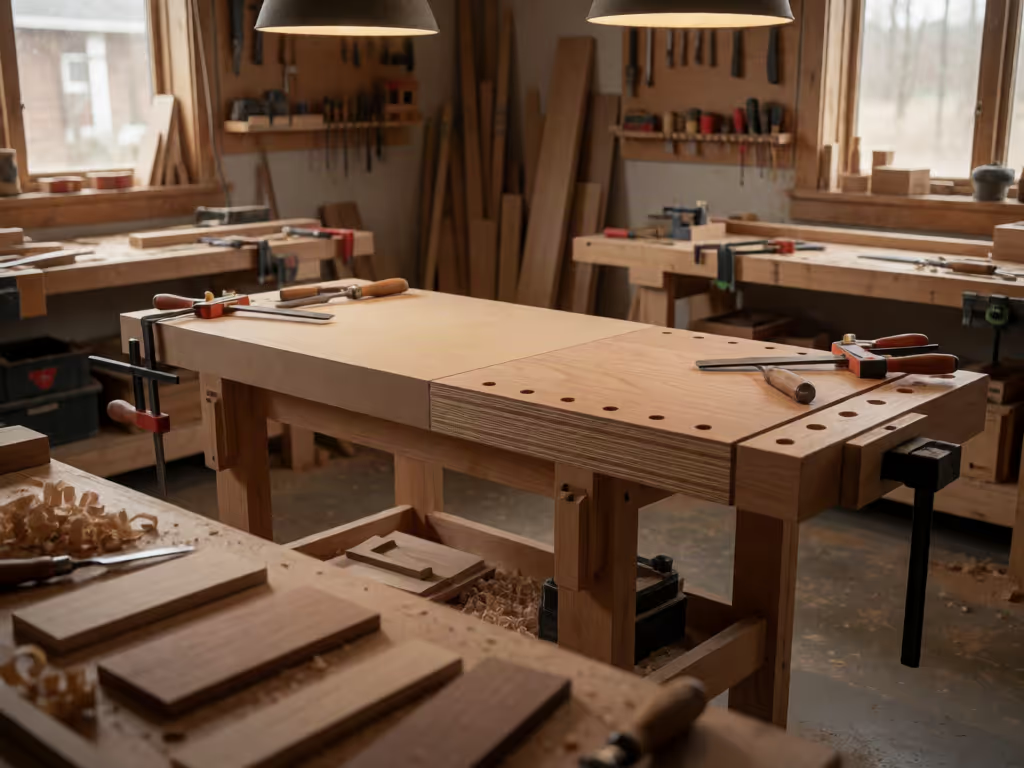
A practitioner example shows why mixed construction is reasonable to investigate rather than dismiss. Rob Cosman describes a bench with a three-layer MDF top on a Baltic-birch plywood frame. That is one builder's construction approach, not a controlled finding that the combination is optimal. Still, it points to the correct design question: what job must each part of the bench perform?
What can actually be said about MDF from the available numbers?
One academic study tested 18 mm MDF against 18 mm melamine-coated particleboard (not plywood). Within that specific test set, the MDF sample reported:
| Test result | MDF sample | Melamine-coated particleboard sample |
|---|---|---|
| Bending strength, as reported | 877.0 N mm-2 | 542.8 N mm-2 |
| Screw-withdrawal strength, as reported | 822.48 N mm-2 | 686.50 N mm-2 |
| Thickness swelling in the study's water-exposure test | 2.85 mm | 4.44 mm |
The numbers are useful only inside their test boundary. They do not prove that MDF is stronger than plywood, stiffer than plywood, better at holding a workbench vise, or more stable in every shop.
For a bench builder, the practical reading is narrower:
- MDF should not be treated as interchangeable with particleboard. In this one 18 mm comparison, the MDF sample reported higher bending and screw-withdrawal values than the melamine-coated particleboard sample.
- Fastener results are interface-specific. The study's screw-withdrawal result reflects its panel, screw, conditioning, and test method. It does not answer whether an edge-mounted vise, dog-hole insert, or repeated fixture attachment will hold in your top.
- Water response needs its own test. MDF is not a single, universal formulation. In a separate experimental 18 mm MDF series, 24-hour thickness swelling ranged from 10.55% for the 0% calcite control formulation to 20.51% for the 9% calcite formulation.
That range is the larger lesson in composite material stability: a generic material label is not a specification.
FAQ: Does MDF make a good workbench top?
It can be a defensible candidate, but validate the top you intend to build
MDF has a documented place in at least one layered workbench design, and the limited MDF-versus-particleboard evidence gives it a better starting point than treating all composite panels as equivalent. But "good" has to be tied to a task and a measurable threshold.
For an assembly and composite-panel-processing bench, define the questions in advance:
- How flat must the engineered wood work surface remain for your glue-ups or routing setup?
- Will clamps load the edge, a sacrificial skin, or a dedicated clamping rail?
- Are screws merely locating an accessory, or repeatedly carrying a high pull-out load?
- Will the top see accidental water exposure?
- Can the top be replaced or surfaced if its working face is damaged?
The source record does not establish MDF's long-term lifespan, flattening interval, or replacement interval. Those unknowns make a practical workbench top maintenance plan especially useful after the bench is built, since inspection and surface care can reveal problems before they require a full replacement. Do not turn an appealing build photograph into a durability forecast.
What about MDF edges?
Cosman describes MDF as having a hard-wearing surface with softer edges, and recommends rounding and treating those edges. That is useful practitioner experience, but it remains an attributed observation, not a comparative durability test.
For planning purposes, separate face performance from edge performance. If your workflow repeatedly clamps, bumps, or mounts hardware at an exposed edge, make that interface a test item. A bench top can look fine across its center while the edge, the part interacting with clamps and fixtures, becomes the limiting component.
FAQ: Is plywood the safer choice for routing and workholding?
There is no collected plywood data that supports that claim
A plywood routing surface may be part of a workable bench design, but the evidence here does not provide matched plywood results for strength, screw holding, swelling, surface durability, flatness retention, or routing performance. It also does not test cutter contact or workpiece slide resistance.
That gap changes the decision method. Instead of accepting "plywood is better for routing" as a rule, use a small offcut trial of the exact plywood and MDF products you are considering. The purpose is not to crown a universal winner. It is to see whether either panel fails your own interface requirements.
A repeatable bench-top test protocol
Build two equal samples or small mock-up tops with the same:
- overall dimensions;
- layer count and panel thickness;
- support spacing;
- fastener pattern;
- clamping location; and
- test load.
Then record four categories.
- Flatness: Place a straightedge across the same marked lines before and after the trial. Record the largest gap with the same gauge method each time.
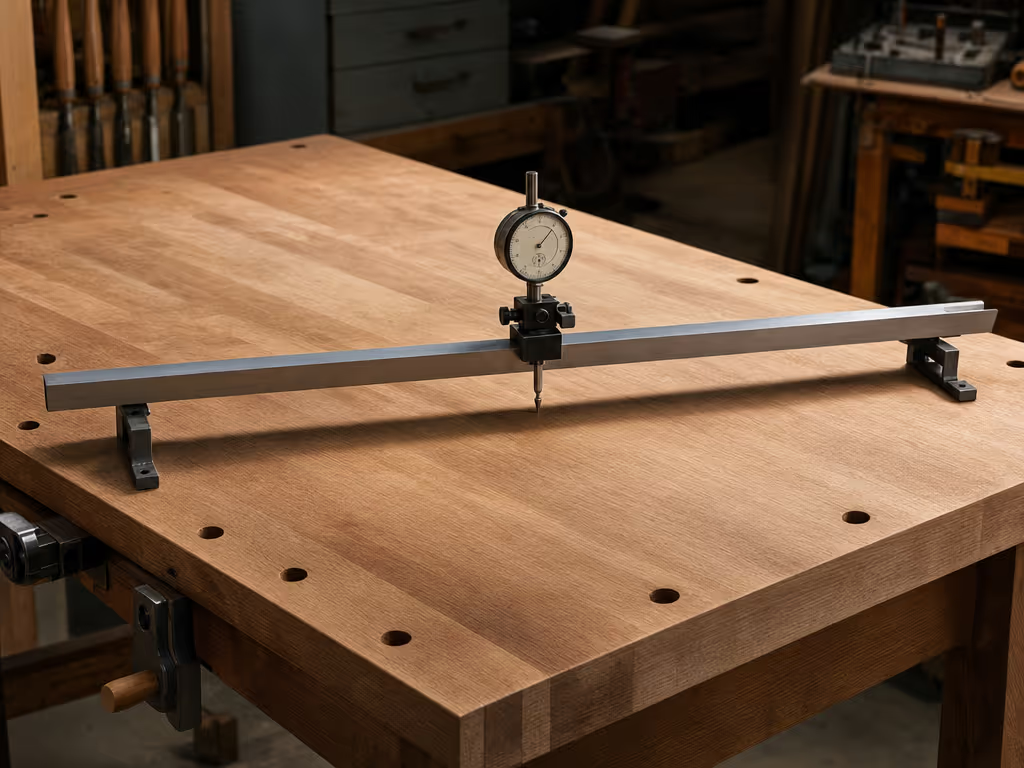
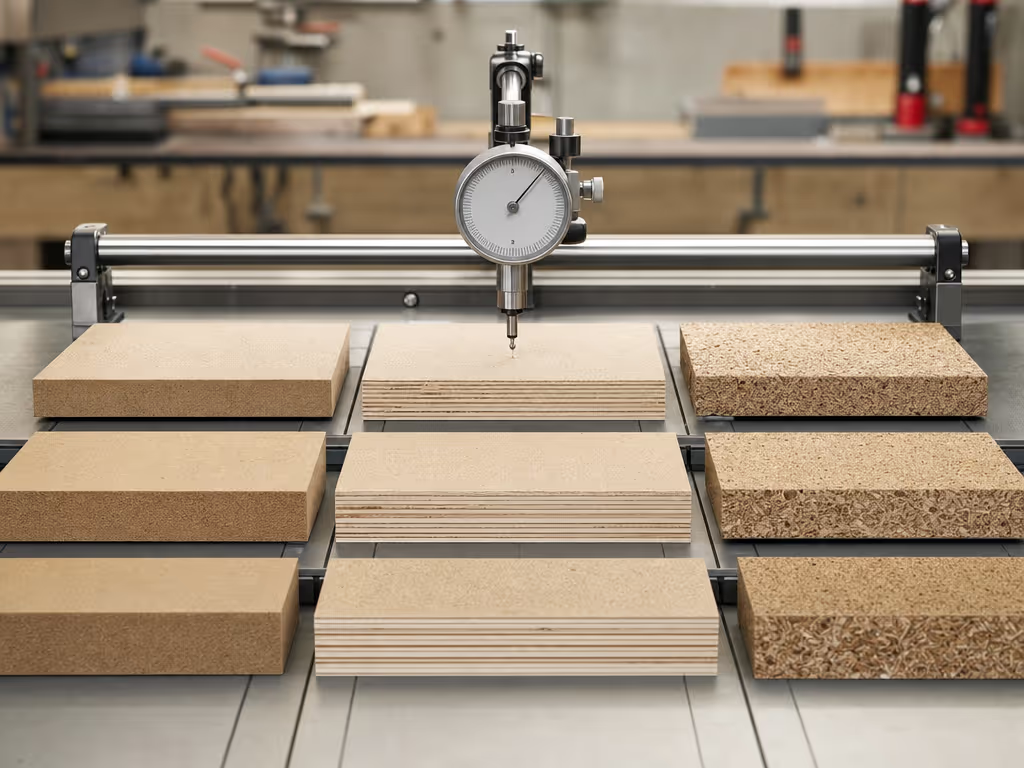
- Deflection: Support each sample identically, apply a measured load at the same location, and use a dial indicator at midspan. Record peak displacement and the reading after unloading.
- Racking response: Attach each candidate top to the same base or mock-up. Apply a repeatable horizontal load at a marked point and record displacement with an indicator.
- Interface retention: Install the intended screw, clamp rail, or fixture in a duplicate sample. Use the same configuration and loading direction each time. Record movement, damage, and whether the interface remains usable.
Do not mix results from different sheet thicknesses, support spans, or hardware and call it a material comparison. Control the variables, and the numbers will explain themselves. Or, in the short version I use at test days: Control the variables, and the #'s tell you what the bench is doing.
FAQ: Can particleboard serve as a cutting or assembly table?
It is a separate material decision, not a substitute verdict for plywood
A particleboard cutting table may be under consideration because it is a composite panel available in sheet form. The controlled comparison above provides one reason to avoid treating it as equivalent to MDF: the study's melamine-coated particleboard sample reported lower bending and screw-withdrawal values than its MDF sample, plus greater thickness swelling in that study's water-exposure condition.
But that is all the comparison establishes. It does not measure a particleboard cutting table under a saw, router, clamp, or bench base. It does not show how a different particleboard product will behave. And it says nothing about plywood.
If particleboard is on the list, use the same mock-up protocol. In particular, test the locations where you expect to fasten, clamp, or expose the panel to moisture. The edge and the attachment point deserve at least as much scrutiny as the broad center field.
FAQ: What are the meaningful downsides of MDF in this application?
Moisture exposure is a measured concern, but not a single-number property
The available studies show thickness swelling after water exposure in specific MDF samples. The first reported 2.85 mm for its MDF specimen under its own water-exposure test. The second found 24-hour swelling from 10.55% to 20.51% across experimental MDF formulations with different calcite content.
The plain-English takeaway: do not assume every MDF sheet will react the same way after getting wet. If the bench will handle frequent glue-ups, compare suitable glue-resistant workbench coatings as part of the surface-protection plan rather than relying on the panel material alone. Keep water exposure in your evaluation plan and test the actual sheet when that risk matters.
Machining dust requires exposure control
Cutting and sanding can put wood dust into the air. OSHA identifies airborne wood dust from those processes as a potential health problem. This is a machining issue: use appropriate source capture and exposure controls when processing MDF, plywood, or particleboard.
Do not overstate what is known. The evidence here does not rank MDF, plywood, and particleboard by dust quantity, particle size, or dust-capture difficulty. It also does not establish that one produces more hazardous dust than another.
Panel emissions and machining dust are different questions
For a current compliance decision, consult applicable rules and the product's labeling or documentation. One manufacturer-published compliance summary, which may not reflect current requirements and is not the underlying regulation, states that TSCA Title VI and CARB formaldehyde standards cover hardwood plywood, particleboard, MDF, and thin MDF. In that summary, the listed figures are 0.09 ppm for particleboard and 0.11 ppm for MDF; treat them as time-sensitive compliance context, not as a substitute for current requirements. These figures also do not measure dust created by machining.
Keep the categories separate:
- Emissions concern the panel product and its applicable labeling or documentation.
- Airborne dust concerns the cutting or sanding operation and the controls around it.
That separation prevents a lot of muddy bench-material debates.
FAQ: How should I choose without buying twice?
Set a pass/fail specification before you cut full sheets
Start with the bench role. If it is primarily an assembly table, measure flatness and vertical deflection. If it carries clamps or fixtures, add interface-retention tests. If it must resist side loading, test racking on the full base-and-top assembly. The collected evidence does not include a racking test for MDF or plywood workbench tops.
Use a simple scorecard:
| Requirement | Test method | Your pass/fail limit | Recorded result |
|---|---|---|---|
| Flatness | Straightedge at marked paths | Set by your joinery work | |
| Vertical deflection | Measured load + dial indicator | Set by your task | |
| Racking | Horizontal load + indicator | Set by your task | |
| Clamp/fixture interface | Repeatable mounted test | No unacceptable movement or damage | |
| Water response | Controlled offcut exposure | Set by your shop risk |
The metric-first approach is not about making a garage bench into a laboratory project. It is about spending one afternoon on samples rather than rebuilding a top after the base, vises, and workflow have already grown around it.
Further exploration
The available evidence supports a careful MDF-versus-particleboard comparison and a practical case for testing your chosen MDF-and-plywood construction. It does not support declaring plywood or MDF the universal workbench-top champion.
Make the next step small: build two matched test panels, load them, clamp them, check them with an indicator, and write down the results. Once you can see flatness, deflection, racking, and interface movement as numbers, the material decision becomes much less mysterious, and much harder for hype to distort.
Related Articles