Textile Workbench Buyer's Guide: Specs That Matter
By Taro Nakamura • 19th Mar
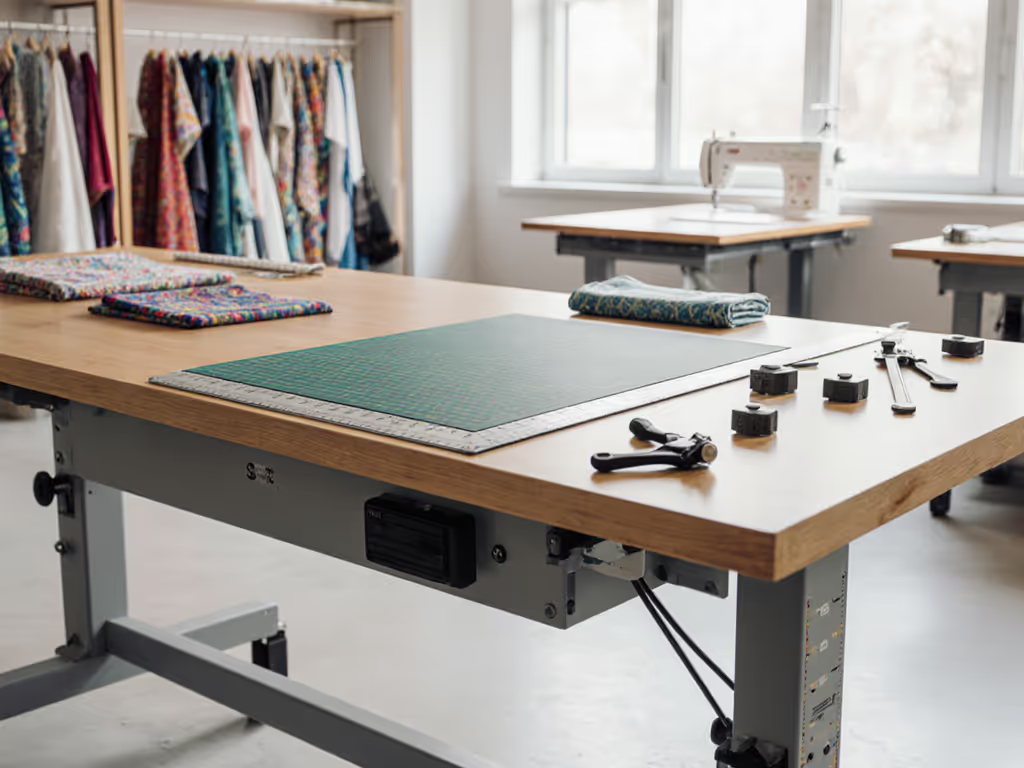
A textile workbench isn't just a table (it is the foundation of repeatability and speed). Whether you're managing a quilting studio, running embroidery operations, or handling fabric cutting at scale, the wrong bench becomes a constraint that no amount of skill can overcome. I've spent years setting up production stations where the bench itself had to vanish into the workflow; when it doesn't, you feel it in every stitch, every cut, and every deadline missed.
Why Textile Work Demands Different Bench Specs Than General Assembly
Fabric and embroidery work live in a different performance world than metal or wood assembly. Your load is lighter (rarely exceeding 500 to 1000 pounds total), but your precision requirements are acute. A wobble during pattern-cutting or embroidery frame mounting telegraphs into finished goods that customers see immediately. You also need unobstructed top space; unlike a woodworker's bench with a tail vise, textile stations must prioritize clean, flat surface area from edge to edge.
The 72 x 36 inch fabric cutting table is the sweet spot for most textile operations. For textile-specific features like anti-static surfaces and fabric-friendly tops, see our textile workbench buying guide. This size accommodates full-width fabric rolls (typically 45 to 60 inches) while leaving room for cutting tools, pattern weights, and operator movement. Smaller benches force awkward reaches or multiple passes; larger ones become obstacles in modest studio spaces.
Height matters more here than in most shop settings. Cutting, sewing, and embroidery frame work all benefit from raised benches (typically 36 to 42 inches) compared to the traditional 34-inch woodworking height. This reduces shoulder strain during repetitive upper-body motion, which accumulates fast in textile workflows. If you're managing multiple operators or shifts, an adjustable-height workbench or stepped approach can accommodate different user heights without forcing posture compromises.
How Much Stiffness and Load Capacity Do You Really Need?
Many textile crafters assume they can buy light-duty furniture and call it a workbench. This assumption fails under real-world rhythm.
A cutting operation involves downward pressure from rotary cutters, pressing feet, and pattern weights (often concentrated on a small area repeatedly). An undersized or flexible top will cup, drift, and lose flatness within months. Industrial-grade craft sewing tables are engineered to resist this deflection. A bench with 1000-pound capacity and a steel-reinforced top handles the cumulative impact of years of cutting, pressing, and clamping without visible sag.
Here's the failure mode: a flexible top starts flat. After six months of daily cutting and heat-pressing (if you add a press to the station), it develops a subtle dish in the center. You don't notice it day one, but by month twelve, your patterns no longer align to the edges, scrap increases, and you've lost precision you didn't know you'd surrendered. A heavier, overbuilt bench (one rated for 1500 to 2000 pounds) simply doesn't move. Overbuild the interface; let precision handle the finesse. This isn't overkill; it's insurance against the slow creep of lost accuracy.
Search for benches with at least 500-kilogram (1100-pound) uniformly distributed load capacity. Below that, you're gambling.
Flatness and Surface Finish: The Hidden Cost of Cheap Tops
A warped or uneven top is invisible until it costs you. Embroidery frame mounting requires dead-flat surfaces; a 1/8-inch dip across a 36-inch span means your frame sits unlevel, and thread tension becomes unpredictable. Cutting accuracy depends on pattern-to-fabric registration, which is hard to achieve if your top is crowned.
Most industrial textile benches use one of three top materials:
-
Laminated plywood with epoxy or polyurethane edge - affordable, replaceable, resists glue and light chemical spills. Common on budget models. Prone to delamination if workspaces are humid; expect replacement every 5 to 7 years in heavy-use settings.
-
Hardwood (maple or beech butcher block) - dense, self-healing from minor gouges, naturally grippy for pattern weights. Requires regular finishing (oil or urethane). Excellent for hand-sewing and framing work; overkill for cutting-intensive stations unless aesthetics matter for client-facing studios.
-
Steel-topped benches with internal reinforcement - industrial default. Zero give, no warping, resists staining and heat. Overkill for most textile work but ideal for hybrid studios that also handle light assembly or pressing equipment. Noisier; requires feet isolation to reduce vibration transmission.
For pure textile work, quilting bench recommendations should prioritize flat laminate or solid wood tops 1.5 to 2 inches thick with internal cross-bracing. If your shop faces persistent moisture, see our humidity-resistant workbench guide for materials and finishes that stay flat. Avoid thin veneers or hollow-core tops; they flex and fail quietly. Serviceable beats sealed. Choose a top you can sand, re-oil, or replace rather than one that's locked to the frame by epoxy or rivets.
Surface Area vs. Footprint: Finding Your Real Workflow Requirement
There's a sharp difference between the size you want and the size you need. I once set up a sewing studio in a gallery space with severe square-footage constraints. The temptation was a massive 96 x 48 cutting table. Instead, we built two 72 x 36 benches that could be pushed together for layout and separated for individual operator work. Same net surface, doubled flexibility.
Ask yourself: What's the largest single item you cut or assemble in one piece? If it's a quilting project (typically 60 inches max width), a 72-inch-wide bench handles it. If you're cutting signage or banners, you may need 84 to 96 inches. Be honest (every extra inch of surface you don't use becomes dead space in your shop and a tripping hazard during setup).
Depth matters equally. A 36-inch-deep embroidery work surface gives you room for the frame, stabilizer, pattern reference, and tool access without forcing you to reach across the entire station. Shallower benches (24 to 30 inches) feel cramped; deeper benches (42 to 48 inches) waste accessibility for solo operators and force you to walk around to reach the far edge.
Depth is where you live during repetitive work; width is where you lay out material.
Storage, Accessibility, and the Workflow Topology
Your bench isn't just a work surface, it is a topology problem. Where do your tools, thread, patterns, and finished goods live? A poorly planned bench forces you to hunt, stretch, or sidestep every few minutes.
Industrial-grade benches typically offer modular storage: lower shelves for rolls and bulk stock, back-panel systems (louvre or pegboard) for tools and thread racks, and drawer units for small-parts organization. For layout ideas and under-bench solutions in tight studios, see our workbench storage guide. These aren't luxuries; they're the difference between a 30-second tool grab and a 2-minute hunt that happens fifty times a day.
Look for benches that accommodate modular accessories without requiring permanent attachment. You want to test a configuration before committing. Standard back-panel systems (louvre panels, square-hole grids, or T-track) let you experiment with layout. Avoid benches that rely on welded or riveted storage; flexibility is more valuable than baked-in layouts.
Related Articles