
Upper Floor Workshop Load Limits: Safe Bench Placement
By Taro Nakamura • 29th Nov
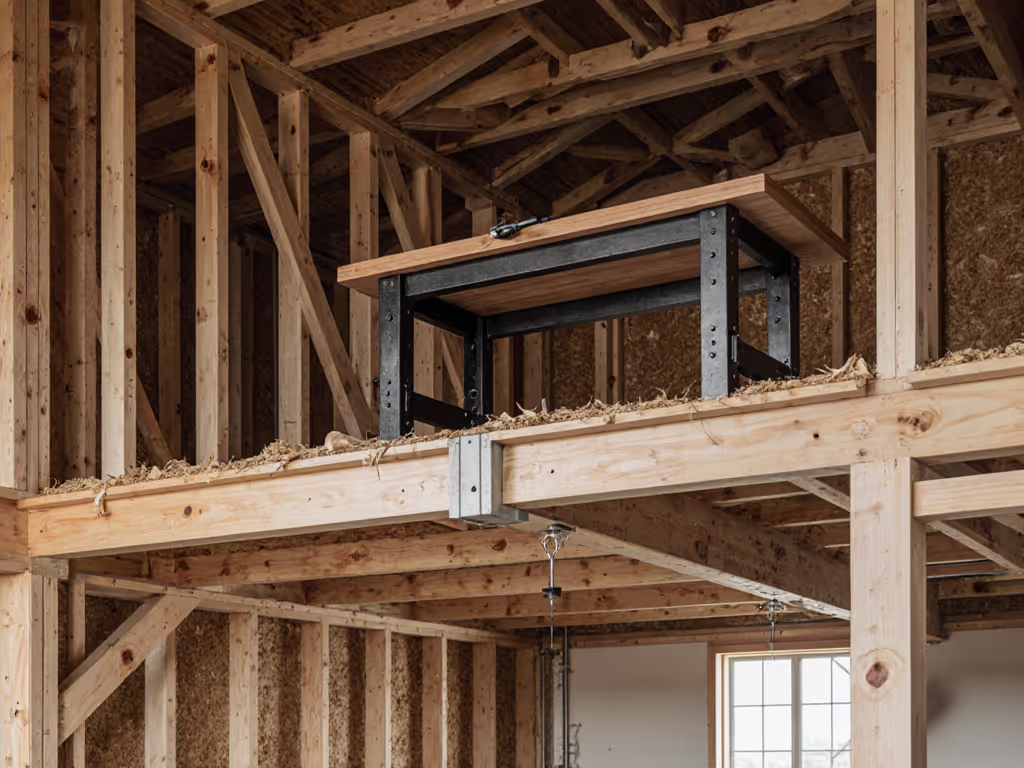
Your heavy duty workshop bench is only as reliable as the floor beneath it. I've seen too many projects derailed because a cast-off upper floor workshop couldn't handle concentrated bench loads, especially when glue-ups fail mid-assembly. Forget novelty; your bench must disappear into the workflow by never becoming the constraint. That means respecting structural load capacity down to the last pound. Here's how failure-mode aware makers avoid costly mistakes.
Why Upper Floor Workshops Are Different
Residential upper floors are typically built to 40 pounds per square foot (psf) live load per International Building Code standards, enough for furniture and people, but not workshop realities. A "heavy duty workshop bench" sitting squarely on a 4x6 ft footprint concentrates weight disproportionately. That's the trap: your bench might handle 1,000 lbs, but the floor beneath might not. For the mechanics behind leg-to-floor load paths and base stiffness, see our workbench stability engineering guide. I learned this painfully when a portable bench collapsed during a film set build (a $500 loss and half a day's swearing). The replacement? Ugly, overbuilt, and forgotten (exactly as it should be).
How Floor Loads Actually Work
- 40 psf means 400 lbs per 10 sq ft, but this is distributed weight. A bench concentrates force at its legs.
- Leg pressure math: A 300-lb bench + 200 lbs of tools/clamps = 500 lbs total. If legs touch just 4 sq in each (a common 2x2" footprint), that's 31.25 lbs/sq in, or 4,500 lbs/sq ft. Yet your floor's distributed capacity is only 40 psf. Bench legs can exceed floor capacity by 100x if not managed.
- Worst offenders: Stacked lumber on benches, vise-induced torque, or uneven weight (e.g., planing heavy timber off-center).
Serviceable beats sealed: Fix a bent leg plate, not a collapsed ceiling.
Critical Assessment: Is Your Floor Safe?
Don't guess. Verify using these field-tested methods:
1. Identify Your Floor's Actual Capacity
Most upper floors in homes built after 1990 support 40 psf (per IBC Table 1607.1). But exceptions exist:
- Older homes (pre-1980s): Often 30 psf or less, especially in attics converted to workshops.
- Garage conversions: May be 50 psf if designed for vehicles.
- Joist span matters: 16" OC spacing with 2x10 joists at 12' spans = 40 psf. 24" OC or 2x8 joists? Capacity drops sharply, often to 25 to 30 psf.
Do this now:
- Tap the subfloor with a hammer. Hollow thunk = weak; solid thud = stronger.
- Check joist depth/spacing in the basement. If joists are < 9.5" deep or spaced > 16" OC, assume 30 psf max.
2. Calculate Your Bench's True Load
Forget the bench's advertised capacity. Focus on what hits the floor:
| Scenario | Bench Weight | Tools/Clamps | Total Load | Load/Sq Ft (4-leg bench) |
|---|---|---|---|---|
| Light duty | 150 lbs | 50 lbs | 200 lbs | 1,200 psf |
| My Roubo-style | 320 lbs | 180 lbs | 500 lbs | 3,000 psf |
| Overloaded | 250 lbs | 400 lbs (lumber stack) | 650 lbs | 3,900 psf |
The verdict: Even "light" benches exceed 40 psf by design. Failure occurs when floor resistance is compromised, like in humid climates where subfloor swelling creates weak points.
3. Spot Hidden Risks in Multi-Story Workshop Design
Common oversights that turn upper floor workshops into time bombs:
- Point loads on seams: Bench legs straddling subfloor seams = instant weak zone.
- Vibration creep: Repeated hammering/chiseling fatigues nails over time, even if initial load is safe.
- Humidity swings: Plywood subfloors lose 30% stiffness at 80% RH (common in poorly vented workshops).
- Concentrated storage: Stacking materials along one wall shifts live loads asymmetrically.
I've seen seasoned makers ignore humidity effects until their assembly bench develops a 1/8" twist after monsoon season. If noise is a concern in apartments or shared homes, see our vibration damping workbench guide for materials and placement strategies that reduce transmission. Workshop floor reinforcement isn't optional (it is insurance against losing half a day to a collapsed glue-up).
Field-Tested Rules for Safe Workbench Placement
Based on 20+ years of building sets and prototypes under clock pressure, here's what keeps projects moving:
✅ The 60% Rule
Never exceed 60% of your floor's theoretical capacity. For a 40 psf floor, that's 24 psf distributed load. For a 4x6 ft bench area:
- Max safe load = 24 psf x 24 sq ft = 576 lbs total (bench + contents).
- If your bench setup hits 500+ lbs, move heavyweight items (tool cabinets, lumber stacks) to exterior walls over bearing points.
✅ Spread the Load Strategically
- Leg plates matter: 6x6" steel plates under legs reduce pressure by 75% vs. bare feet.
- Diagonal bracing: Bolt 2x4 braces between bench legs and the floor (if permanent). Turns rack into compression.
- Avoid casters on upper floors, they concentrate load and amplify vibration. Leveling feet beat mobility here. If mobility is unavoidable, use the right workbench caster system to maintain stability and distribute load safely.
✅ Test Like a Pro
Before committing:
- Place a 50-lb bag of concrete mix at each leg position overnight.
- Check for creaks, gaps between subfloor/joists, or visible deflection (>1/8").
- No issues? Repeat with 100-lb bags. Still solid? You're good for 400-lb setups.
Final Verdict: Make Your Bench Disappear
An upper floor workshop can handle serious work, if you treat structural load capacity like soldering temperature: non-negotiable data, not a suggestion. Overbuild the interface; let precision handle the finesse. I'd rather patch a bolt hole in a steel leg plate than scrape epoxy off ruined set pieces because the bench failed. Serviceable beats sealed every time.
Your bench's job isn't to impress, it is to vanish into the workflow while holding true under planing pressure, clamping torque, and humidity swings. Respect the floor's limits, spread concentrated loads, and prioritize repairability. Do this, and your "heavy duty workshop bench" will finally do what it's meant to: disappear while you get work done.
Related Articles